Ukraine Proved Cardboard Drones Work - Japan Was Paying Attention
The Corvo PPDS looked ridiculous until it started blowing up Russian aircraft on the ground
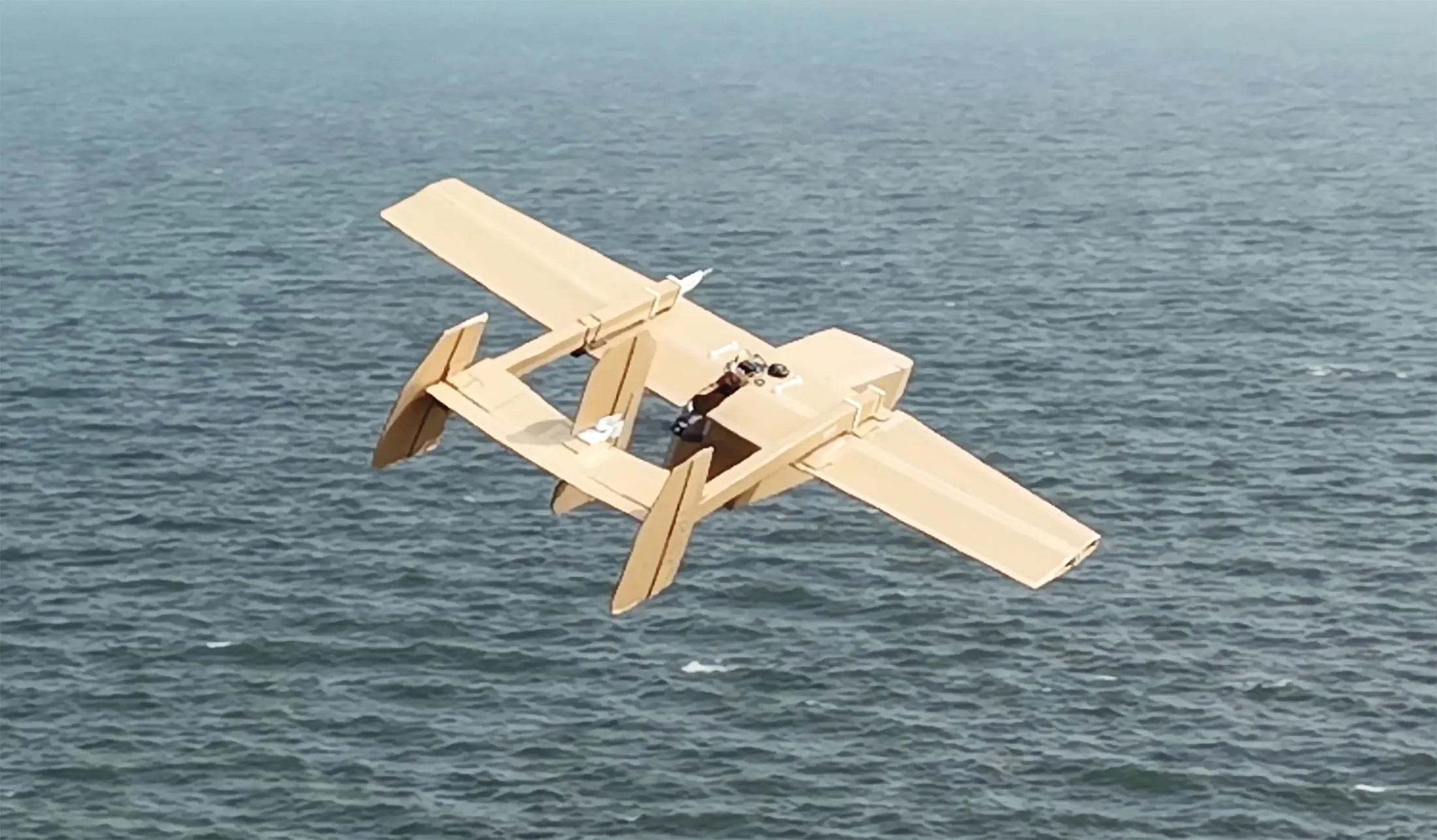
A little over two years ago, I wrote a piece that felt almost absurd to publish. Ukraine, I reported, was using flat-packed, tape-and-rubber-band drones, made of waxed cardboard, shipped like IKEA furniture, to blow up Russian fighter jets on their home airfields.
Here’s that piece over on Medium if you’re feeling froggy.
The comments were occasionally skeptical.
And yet…
This week, Japan’s Defense Minister was photographed smiling alongside the AirKamuy 150, a disposable cardboard swarm drone developed by a Japanese startup of the same name. The country is already eyeing it for deployment with the Maritime Self-Defense Force.
The cardboard drone has gone from Australian lab down unda, to Ukrainian battlefield improvisation, to mainstream defense procurement in Japan, and it’s accelerating faster than most analysts expected.
Let’s catch up on where this all started, where it stands today, and what Japan’s entry into the arena tells us about where modern warfare is heading.
The Corvo: A Quick Refresher
In August 2023, I covered Ukraine’s use of the Australian-made Corvo Precision Payload Delivery System (PPDS), built by Melbourne-based SYPAQ Systems.
The airframe is made of waxed foamcore, ships as a self-assembly flatpack, has a range of up to 120 km, and costs between $670 and $3,350 depending on the version.
That is EXTREMELY cheap for an attack drone, but somehow still seems kind of expensive for cardboard.
The Corvo was originally designed for reconnaissance and logistics resupply, but Ukrainian forces repurposed it as a highly effective kamikaze weapon, capable of carrying up to three kilograms (about 7 lbs.) of explosives.
The headline moment came on the night of August 26–27, 2023, when the Security Service of Ukraine conducted a special operation against the Russian Air and Space Forces base at Kursk Vostochny Airport, attacking four Su-30 and one MiG-29 aircraft using Corvo PPDS kamikaze drones, (and also destroying an S-300 radar and two Pantsir-S1 air defense systems)!

Sixteen Corvo drones were reportedly used, with three shot down by Russian forces.
A few pounds of waxed cardboard and commercial-off-the-shelf electronics.
Tens of millions of dollars in damage.
Bang. For. The. Buck.
The Corvo’s operational record in Ukraine has continued to impress, and the field innovations coming out of the front lines have been genuinely remarkable.
Ukrainian soldiers have been cutting holes in the bottom of Corvo airframes and mounting GoPro cameras on 10-second timers to film short clips when the drones reach their pre-programmed turnaround point.
This improvised ISR configuration makes the drones even harder to detect, since there’s no datalink streaming video back or receiving navigation instructions. No signal means nothing for Russian electronic warfare to grab onto.
The drone flies its pre-programmed route, snaps its photos at the waypoint, returns, and lands, and the entire mission happens in complete radio silence.
Now I know what you’re thinking… Hey Wes, doesn’t the cardboard make it basically a budget stealth RQ-170 Sentinel?
YES! Well, I mean, technically radar could detect cardboard drones, but they’re much harder to detect than conventional drones of the same size.
The Corvo PPDS airframe is made from waxed foamboard-cardboard-like material, which gives it a tiny radar return compared with an aluminum aircraft or even a drone with more metal structure. It’s slow, small, light, and mostly non-metallic.
That’s a nasty little radar problem.
But “hard to detect” isn’t “invisible.” The drone still has a battery, wiring, motor, servos, payload, fasteners, and either a camera or warhead.
Those components can reflect radar energy. The propeller can also create micro-Doppler signatures, though a small electric prop is not exactly an F-16 waving a neon sign.
Low altitude flight also makes detection harder because the radar has to sort the drone from ground clutter, trees, buildings, terrain, birds (AKA real Corvids lol), and all the other nonsense living near the horizon.
The bigger issue is radar type.
A large air-defense radar is optimized for the big, fast, dangerous things modern militaries have worried about for decades: jets, helicopters, cruise missiles, and ballistic threats.
It uses Doppler processing and clutter rejection to separate real targets from the background. That works well when the target is moving fast enough and reflecting enough radar energy to stand out.
A cardboard drone like the Corvo PPDS attacks that assumption. It is small, slow, low, and mostly non-metallic, which means its radar return can be weak enough and its speed low enough to resemble clutter.
A short-range counter-UAS radar is designed for exactly that ugly problem. These radars often use higher operating frequencies, shorter detection ranges, finer range resolution, high update rates, and specialized algorithms to separate drones from birds and background clutter.
Some systems also exploit micro-Doppler signatures, which are tiny radar modulations caused by spinning propellers or rotor blades. Research on drone radar detection specifically focuses on extracting weak drone signals from clutter using Doppler and signal-to-clutter methods, because small drones often produce weak returns that conventional detection methods can miss.
So, it gives up the massive range of a strategic air-defense radar in exchange for short range sensitivity and classification against small drones.
But by the time a cardboard drone is close enough to be detected by your short-range counter-UAS radar, your reaction time is smashed as thoroughly as your wrecked Su-30 on the ground.
That’s the tradeoff. Big radars protect the sky. Counter-UAS radars police the weeds.
Cardboard drones live in the weeds, because of course the cheapest thing on the battlefield found the most annoying place to hide.
Also, the field-repair culture around the Corvo has been equally impressive. Ukrainian operators have been patching battle-damaged airframes with whatever cardboard they could scavenge from their surroundings.
Individual Corvo units have survived more than 20 flights, and the waxed cardboard wing handles moisture without losing its aerodynamic qualities.
One source puts that durability figure even higher; some PPDS drones in Ukraine have managed to make 60 flights total.
The volume of the program has been staggering. SYPAQ has been churning out 100 Corvo drones monthly for Ukraine since March 2023.
Now, the company has unveiled a heavy-lift version of the PPDS capable of transporting six kilograms of payload, essentially doubling the warhead or sensor capacity of the original design.
The PPDS-HL also adds external hardpoints, meaning it can carry and drop payloads in flight rather than relying solely on the kamikaze profile.
The feedback loop between the Ukrainian military and the manufacturer has been unusually tight.
Heavy Ukrainian use of the drone for complex missions has generated significant feedback that SYPAQ is using to improve the mission planning system, user interface, and ground control station across the entire Corvo drone family.
This is asymmetric innovation at its finest: combat experience, absorbed in real time, fed directly back into the production cycle.
Enter Japan
Which brings us to the AirKamuy 150.
Japan’s post-WWII constitutional framework has created a deep institutional and cultural aversion to anything that looks like offensive military capability.
That aversion actually runs through the venture capital community. While AirKamuy secured 100 million yen in April 2025, roughly two-thirds of approached investors declined; a common reason being internal policies restricting investment in defense-related businesses.
CEO Yamaguchi has described facing a “double barrier” of defense tech and hardware investment skepticism, compounded by the reputational risks unique to the defense sector in Japan’s postwar cultural context.
The strategic logic driving that signal is straightforward.
Japan is an archipelago nation responsible for defending over 6,800 islands, many of them remote, some of them contested.
The Senkaku Islands sit at the center of an active territorial dispute with China.
Taiwan’s strait is close enough to Japan’s southwestern island chain that any conflict scenario there immediately becomes Japan’s problem.
And the Maritime Self-Defense Force, however capable, cannot physically patrol every kilometer of Japan’s sprawling maritime frontier.
A swarm of $2,000 cardboard drones, pre-positioned across remote island outposts, changes that equation considerably.
Like Corvo, the AirKamuy 150 can be assembled in under five minutes, shipped flat-packed in bulk, and deployed by personnel without specialized technical training. Its speed of 120 km/h and 50-mile range make it viable for maritime patrol, early warning, and area denial in exactly the kind of island-chain geography Japan needs to defend.
Japan’s fiscal 2026 budget request allocates 312.8 billion yen for “unmanned asset defense capabilities;” roughly triple the previous year’s amount.
The AirKamuy 150 is arriving at precisely the moment that political will has matured into funding. And Japan is not alone: South Korea unveiled its cardboard “PapyDrone-800” in 2024 and decided to adopt it for military use.
North Korea has also showcased cardboard drones with rubber band-connected wings at a Pyongyang defense exhibition. The low-cost drone development race is already accelerating across Asia.
The proof of concept that Ukraine field-tested over Kursk has now been absorbed by three Asian militaries simultaneously.
Two plus years is a fast adoption curve for any weapons technology. For a technology made of cardboard, it’s remarkable.
When I published my 2023 piece on the Corvo, the core argument was simple: cheap, expendable, and nearly invisible beats expensive and irreplaceable. A $3,000 drone that damages a $30 million fighter jet degrades the adversary’s capacity to replace what it’s lost.
Ukraine proved the concept in a real shooting war, against real air defenses, over Russian territory. The results were damaging enough that the Russians initially denied the August 2023 strike even happened at all. Commercial satellite later proved it did, as Ukraine had described all along.
Now South Korea, Japan, and by all appearances many other militaries are drawing the same conclusions.
The cardboard drone was never a novelty. It was a proof of concept. And the concept passed its test.
I said it in 2023 and I’ll say it again: I hope the US and its allies are taking notes. Close-in weapon systems like the Phalanx are good, but when a swarm of 500 $2,000 drones comes over the horizon, you need something to meet them.
The AirKamuy 150 is proof that at least one nation, Japan, is learning from the Ukraine War.
Слава Україні!
Note: I’ve restricted the comments to paid subscribers due to a proliferation of Putin-loving trolls Have a great Air Force day!


That Amazon delivery truck driving down the street may contain an entire air force of drones.
Wes, as a graduate Aeronautical Engineer many many years ago, I am absolutely delighted that Ukraine and now Japan are using cardboard drones! Thank you for writing this. It made my day! PS I had no idea they even existed!