What Would Happen if Trump Contested the Midterm Elections?
A foreign intelligence threat is becoming Trump’s domestic political weapon

Well, I was going to write about Mykhailo Fedorov today; you know… the guy who served as Ukraine’s defense minister for six months, was largely responsible for modernizing Ukraine’s now envy-of-the-world drone force (among many other achievements) and was dismissed as part of a government reshuffle.
Instead I have to write about the small matter of saving democracy. (Don’t worry, I’ll get the Fedorov piece finished soon).
Today, I need to walk you through something carefully, because what just happened last night was designed to be understood fast and wrong, rather than slowly and right.
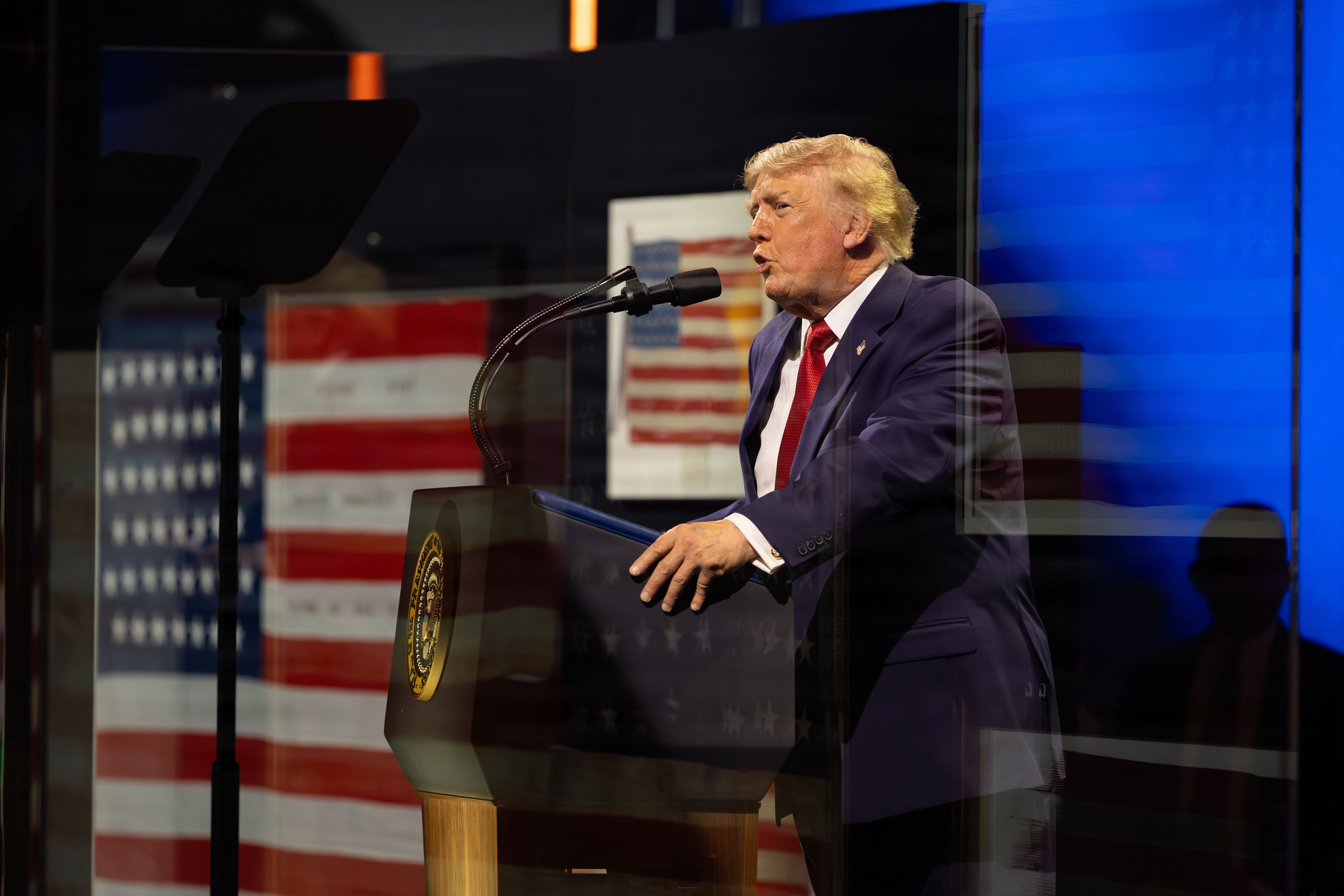
Thursday night, in a primetime address from the East Room, President Trump announced the declassification of a stack of intelligence documents. He then told the country, with a strait face, that China had carried out “the largest compromise of election data in history,” illicitly acquiring 220 million American voter files starting in 2020.
He called it an unprecedented election security nightmare. (Hyperbole.)
He said the “deep state” buried it. (Sure grandpa, go back to bed.)
He said China didn’t want him to win. (This is actually true.)
And he tied all of it, directly, to the November midterms and his push to pass the SAVE America Act.
Returning readers should know I spent time around military intelligence, and I’ve got a professional bullshit alarm sensitive to taking raw reporting and promoting it past what the evidence can actually hold.
A foreign government possesses a capability, an intelligence service considers an operation, an analyst flags a vulnerability, and a source reports a possible plan. None of those things, individually or stacked in a pile, proves that the operation happened, succeeded, or changed a presidential election.
Intelligence work exists to keep those distinctions straight. Trump just smashed them together.
Let me start with the part that’s true…
Beijing has every reason to collect data on voters, campaigns, parties, policymakers, and public opinion. That kind of material feeds espionage, influence targeting, cyber operations, and long-term study of how Americans behave politically.
China should never be underestimated. They have a mature, extremely well-run intelligence gathering machine.
But here’s the fact that got buried under the word “nightmare.”
A voter file is not a ballot.
Voter registration data is, in much of the country, public or commercially available.
North Carolina posts voter-level records right on its elections website.
The chair of Wisconsin’s elections body pointed out Thursday night that if China bought Wisconsin’s voter data, they bought something anyone on earth can buy, including you.
So, when the White House says tens of millions of records across 18 states were “bought, stolen, or hacked,” that phrasing is doing a magic trick. It welds together four completely different events, buying public lists, scraping public records, stealing protected data, and hacking an election system, and hides the one fact you most need: which one actually happened?
Buying a public list and hacking the machine that counts votes are not the same crime. Hell, one of them isn’t a crime at all. They’re barely the same category. And the released material does not establish the second one.
But more egregious is the intellectual con job at the center of the whole speech. There are five distinct things here, and intelligence analysts don’t treat them as synonyms.
Trump treated them as one word.
Vulnerability is a system having a weakness someone could exploit. A weakness proves a door could be opened. It does not prove anyone walked through it.
Collection is a foreign government gathering information about voters, candidates, demographics, or public sentiment. Spying, basically. It tells you nothing about votes.
Influence is trying to change minds through propaganda, covert social media campaigns, leaked or fabricated stories, and division-farming. Russia did this in 2016 and 2020 to benefit Trump.
Interference is attacking the actual machinery of an election: registration systems, ballot casting, vote counting, or results reporting. This is where the threat moves from persuasion into the administration of the election itself.
Manipulation is the most damaging category: successfully altering registrations, ballots, vote totals, or reported results. This is the point where an attacker actually changes the election.
Those five words are five different points on a threat chain, running from ‘a weakness exists’ to ‘someone changed the result.’ The distance between the first and the last is the entire difference between a locked door and a robbery.
Thursday night, the President crashed straight through all five without once touching the brakes, and invited you to arrive at the last one, manipulation, using evidence that only supports the first two.
What the intelligence actually said
The March 2021 assessment was produced by the National Intelligence Council with the CIA, FBI, NSA, DHS, and others. It was run under John Ratcliffe, who was Trump’s Director of National Intelligence at the time and is Trump’s CIA Director right now.
That assessment found no indications that any foreign actor altered any technical aspect of the 2020 vote: not voter registration, not ballots, not the count, not the reporting.
On China specifically, it judged that Beijing considered but did not deploy influence efforts meant to change the outcome and did not conduct interference against the machinery. High confidence.
One official dissented, the National Intelligence Officer for Cyber, who believed China took some steps to undermine Trump. That dissent is real and it’s been public since 2021. But even that minority view did not conclude China changed a single vote.
As Senator Mark Warner put it Thursday, the concurring opinion suggested China may have tried to sway opinions, and that’s been on the record for years.
Look, I’m not asking you to treat intelligence assessments as holy scripture. Sometimes agencies miss things. Sources lie. Minority views sometimes turn out to be the right ones.
If genuinely new reporting has surfaced, the correct response is a fresh, coordinated assessment that weighs it against the whole body of intelligence. The incorrect response is to hand-pick raw documents, strip off the confidence levels and the dissents and the definitions, and announce that the President’s preferred conclusion has been proven.
The first is analysis. The second is narrative construction meant to bamboozle American voters.
The documents don’t say what he said they say
Reuters found the trove cuts against the truth in places. One document assessed that vote tabulation systems would be difficult to manipulate on a scale large enough to change a result.
A CIA document said Beijing did not intend to covertly interfere to sway the outcome, though it might reconsider later.
Another release was about Venezuela manipulating Venezuela’s own election, which has precisely nothing to do with American ballots.
And per CNBC, one of the administration’s own documents states flatly that Beijing did not interfere with election infrastructure, including vote tabulation or the transmission of results, which directly contradicts Trump’s Thursday claim that China’s activities included an attempt to manufacture illegal ballots.
A source with direct knowledge told reporters the release was meant to round up everything the government had tied to those old reports, and that when the additional underlying material got vetted, it wasn’t considered credible or consequential enough to have been included in the original assessment.
In other words, the stuff that got left out got left out for a reason.
So, what did the White House actually release?
Shocking evidence that foreign governments collect voter information, study our election systems, possess cyber capabilities, and consider political operations!
Jay-zus boy-o, that’s the resume of every hostile intelligence service on the planet.
Actually, the 2021 assessment found that two countries did run influence operations in 2020: Russia, which worked to damage Biden and help Trump, and Iran, which worked to hurt Trump.
Neither changed any votes, but both actually ran operations. China, by the consensus finding, considered and declined.
A serious briefing on foreign threats to the 2020 election would start with the countries that actually did something. Trump built his primetime address around the one that, per his own former DNI, didn’t. He centered the country whose story fits the claim that foreign forces stole his victory and gave short shrift to the country the intelligence community says actually tried to help him.
So, dear friends, here’s my warning:
I have no evidence that Trump has already decided to reject an unfavorable midterm result. Nobody does.
What I can see is the structure and the timing, and both give every reason for concern. Look at the argument he laid out Thursday and notice that it assembles, brick by brick, into a ready-made challenge to November:
Foreign governments hold your voter data. (Not surprising or new information)
The systems have vulnerabilities. (Sure, every system does)
The rolls contain questionable records, non-citizens, errors. (A tiny minority)
The intelligence agencies hid the danger. (False. They didn’t)
State officials haven’t fixed it. (There was nothing to overtly fix)
Only his preferred federal legislation can secure the vote. Therefore, any result produced before those changes is inherently suspect.
He delivered that months before the midterms, explicitly named the coming election, announced his administration was notifying states, promised further DHS action, and demanded Congress pass his bill.
The ranking Democrat on the House committee that handles federal elections called it on C-SPAN: a pretext to dispute 2026 in advance.
Here’s the mechanism for killing a democracy: Trump doesn’t need to prove after the election that November was stolen. He needs enough Americans to believe, before a single ballot is cast, that any Republican loss could only be the product of a rigged system.
We’re witnessing preemptive delegitimization, and it quietly reverses the burden of proof.
Normally the person alleging a stolen election has to prove it happened. This framework flips it: the systems have weaknesses, the adversaries have capabilities, the data exists overseas, and officials can’t prove with total certainty that nothing happened, so the result stays suspect.
This standard can never be satisfied, because no complex system on earth can prove the complete absence of every theoretical vulnerability. Under that rule, no American election is ever legitimate unless the preferred candidate wins.
I support the American intelligence community.
That does not mean I think every assessment is correct or every agency is above scrutiny. It means I respect the analytic process enough to recognize when someone is abusing it.
The 2021 assessment defined its terms. It stated what analysts knew, what they assessed, and where their confidence sat. It even included the dissent on China.
Trump extracted the most politically useful fragments and threw away the caution labels they came wrapped in.
Americans are being trained to believe that elections are mysterious, fragile, secretly manipulated, and legitimate only when they produce the right winner.
Election security deserved a far more serious treatment than it received Thursday night. If China obtained protected voter data, that should be investigated thoroughly, and any vulnerable systems should be patched without delay.
States should maintain accurate voter rolls, regularly test and audit election equipment, and preserve paper ballots and post-election hand counts, since those safeguards are what allow officials to detect manipulation in the first place.
Genuine foreign influence operations should also be exposed and disrupted.
All of this is serious, necessary work, and I want the government to do it well.
But protecting an election means naming the specific system, the specific intrusion, the specific actor, the specific action, and the specific effect.
Trump offered a fog of alarming facts and unproven allegations and invited the country to assemble them into the conclusion he wanted.
But a serious country keeps its definitions sharp. It separates spying from influence, influence from interference, and interference from a result that was actually changed.
Last night, from the East Room, those boundaries got erased on purpose and replaced with something simpler: the system is broken, they hid it from you, and November can’t be trusted unless he gets what he’s demanding.
So, let me answer the title question: What would happen if Trump contested the midterm elections because of voter fraud or foreign interference?
Well, we should first acknowledge that election-night projections aren’t official results. State and local officials would continue counting eligible ballots, reconciling ballot totals, conducting required audits and recounts, and certifying winners under state law.
The president doesn’t supervise that process.
Trump could demand investigations, order federal agencies to examine credible foreign-intelligence or criminal allegations and use the White House to pressure state officials. His political allies could file lawsuits and request recounts where state law permits them.
None of those actions would automatically stop certification.
The immediate question would be simple: What evidence connects the alleged fraud or foreign interference to a specific race and enough ballots to change its result?
A claim that China possessed voter-registration information wouldn’t answer that question. Neither would proof that a voting system contained a theoretical vulnerability. To overturn a certified result through litigation, challengers would generally need evidence tied to particular unlawful votes, rejected lawful votes, compromised systems, or official misconduct, along with a legal reason to believe the problem could have affected the outcome.
The White House saying “foreign interference occurred” would begin an inquiry. It wouldn’t complete one.
So, would the newly elected members still take office, even with claims of voter fraud?
Technically, yes…
Candidates certified as winners by their states would normally present their credentials and be sworn in. Trump has no constitutional role in seating representatives or senators, and he can’t veto their membership.
There is one major wrinkle: Article I gives each chamber the authority to judge the “Elections, Returns and Qualifications” of its own members. The House handles formal challenges under the Federal Contested Elections Act, with the Committee on House Administration examining the record before the full House can decide the contest by majority vote. The Senate has parallel constitutional authority over its own elections.
That means a disputed congressional race could unfold in several ways:
A state might certify the apparent winner, who is then seated while a contest proceeds. The House or Senate might delay seating someone while examining unusually serious evidence. A state might fail to certify before January 3, leaving a temporary vacancy. Ultimately, the relevant chamber can decide who won.
This is where the composition of the incoming Congress becomes critical. If control of the House depends on three disputed seats, the fight over who gets seated could determine which party controls the body that decides those very contests.
Constitutional machinery can occasionally resemble a committee assigned to investigate who gets to chair the committee.
Still, a blanket presidential statement that “all Democratic victories are fraudulent” wouldn’t itself provide a lawful basis for excluding certified members.
Could Trump declare martial law shortly before the election?
Let’s not give the guy any ideas… lol
He could announce anything he wanted. He could announce Elvis Presley has been found on Saturn’s moon Titan. The announcement wouldn’t give him the power he claimed.
“Martial law” isn’t a constitutional cheat code that temporarily converts the presidency into a dictatorship. The Supreme Court’s historic rule in Ex parte Milligan is that martial rule can’t replace civilian authority where civilian courts remain open and functioning.
The Insurrection Act does provide broad and troubling authority to deploy federal troops or federalized National Guard forces when rebellion, domestic violence, or obstruction makes ordinary enforcement of federal law impracticable.
Those provisions concern enforcing law and suppressing insurrection. They don’t authorize the president to cancel elections, rewrite election statutes, suspend the Constitution, or extend congressional terms.
But there is one dangerous scenario that we should watch for:
The administration could claim “classified” proof of foreign interference.
The president could say the evidence was too sensitive to release publicly. Members of Congress might receive conflicting classified briefings. Intelligence leaders could disagree about whether collection showed a plan, an attempted intrusion, a successful breach, or actual manipulation.
Public debate would then occur while much of the evidence remained hidden.
Courts can review classified information through protected procedures, and congressional intelligence committees could investigate. State officials would still need enough specific information to protect systems, examine records, or challenge results.
The good news is that the administration couldn’t reasonably say, “Trust us, the election was stolen,” while withholding every fact required to identify the affected races.
Intelligence can protect sources and methods. It can’t replace proof when the proposed remedy is disenfranchising millions of citizens.
But the most likely path is perhaps the worst for long-term American democracy:
Trump declares the results suspicious.
Republican candidates refuse to concede.
Lawsuits multiply.
Certification boards face pressure.
Federal agencies announce investigations.
Classified claims circulate without enough public detail to evaluate them.
Threats drive election workers from their jobs.
Congress disputes several close seats.
And then millions of American voters conclude that the government taking office in January lacks legitimacy.
We don’t yet know whether he’ll contest the midterms. We do know he spent Thursday night handing out the argument for it, pre-assembled, months early.
He went on television to warn America about a threat to the next election. By teaching millions of people to distrust that election before a single vote is cast, he just became the very threat he’s warning us about.
The big question in my mind is: how will Americans respond if their chosen candidates win an election legitimately, and then get told by the president that their votes are null and void?
I suspect they won’t be happy.
Слава Україні!
Wes O’Donnell is a journalist, veteran, and defense analyst focused on the Ukraine War, military technology, and global security. He served in the U.S. Army infantry with the 101st Airborne Division and later in the U.S. Air Force as a Surveillance Radar Journeyman on the E-3 Sentry AWACS during the Global War on Terror. He holds a B.A. in International Relations (Russian Studies), an MBA, and a J.D., bringing a mix of operational military experience, legal training, and strategic analysis to his scribblings.
I’m leaving the comments open to the public for now, but my rare political posts tend to attract trolls. Please use the report function in the comments if needed. Stay sharp.


Not if, when.
And I will jump with both feet into the he wants to. The Law will only stop him as long as it can. He is closing American society. He wants to be the last president, and the first king, dictator, whatever you want to call it.
The threat is very real, and we must stop pretending that the courts, especially SCOTUS, will save us. In effect, have had these convos in private DMs with friends, as well as physical convos with family. We are already in a cold civil war. Trump may force the issue into a hot civil war.
Not here to cheer ya. After all, that’s not my job. But this is a warning from how many countries, including the US, twice, have ended up in hot civil wars.
My first thought, the insight inspired by your question, is this, “What is going to happen when Trump contests the midterm elections?”, because he absolutely is going to. We all know it.